Love You

Tuesday, 29 November 2011

Place Value

The purpose of this blog has always been to allow parents into the world of their children as students, learning new concepts, practising, making mistakes and then finally, after much hard work, being successful.  Sometimes it takes a great long time to understand the value of new ideas.
The best way to learn is to be able to hinge our thoughts and ideas onto a real life experience.  In teacher talk, that is called scaffolding.  The students in Grade two are just beginning to work specifically on the concept of place value for numbers.  I decided that a real life application would be to count groups of objects that are really large.  We read a story about the Masloppy Family who took inventory of various collections of items in their home.  We have been taking inventory of items in our class.  On the first day, pairs of students counted bins of books.  As I watched and listened I finally heard a child count by 2's and not singly.  It was then that I called a math congress.  Basically that is an opportunity for all students to share their ideas in a safe way within the class, knowing that their ideas are valued and helpful to others.
Once we discussed why counting by 2's worked better than counting by 1's (the smart child told us it was much faster!), I encouraged the students to choose other groups to count by.  The group today that was counting keys, decided to count by 2's until 100, then they went onto create another group of 100 and so on.  Here they are using pen and paper to record their ideas.  That's the other thing that is different than when you (parents) went to school.  The teacher doesn't immediately tell you the best way to do something.  The students discover through some trial and error and then through sharing during the math congress, what ways work best for them, or which may be more efficient.


These girls decided originally to count the centicubes by 5's but when they saw how many groups they were getting, they changed their strategy and moved 2 groups of 5 together so they would have groups of 10.  They were making decisions based on their needs in the situations...that's becoming real problem solvers!
It was also interesting to hear  one girl share that when she was making groups of 5, she looked for groups of 2 and groups of 3 to put together (rather than counting individually up to 5).  She is demonstrating her understanding of composing (putting together) numbers!

Finally, another girl shared that she and her partner chose different groups to count by depending on how many items were in the container they were going to count.  If the amount seemed small, they counted by 2's, but if the amount was larger, they grouped by 5's and when they thought the amount would be very  large, they then used groups of 10's.  Math is about making sense of the world around you.  Listen to how your child is thinking BEFORE telling them how you would solve the problem!

Sunday, 27 November 2011

Attributes

What are attributes?  Why are they important?  What subject would we use them in?

Attributes are the characteristics of something that we are discussing.  They are important because they show the similarities and the differences between a number of objects.  For that reason we use them in all subject areas.  Currently and concretely, the students are looking at how to sort objects by attributes in mathematics.  How are the keys the same?  Sort them into two or more groups and ask your partner to name the attributes that you were using to create the groups.  For example, you can sort buttons by the number of holes they have or sort keys by the shape of the tops.

What attributes did the girls use to sort these flowers?

How to Blow a Bubble

The fun of the Fiftieth Day of School just keeps hanging on!  Writing non-fiction is very different than writing fiction and having some experiences to 'hinge' our understanding onto makes the actual exercise much easier.  Bubblegum was a relatively new chewing delight in the 1950's and being able to blow a bubble with gum is a sign that you are really growing up!

What are the items that are needed if you want to blow a bubble? What are the steps to creating a bubble?  Could you write these down in full sentences in order and have a reader follow them?


When the students write their sentences, they have had the opportunity to try, to talk and share with others, have created a plan and have reminded to use the mechanics of writing appropriately.  For all of that, you will notice that some still do not start sentences with an uppercase letter, end with punctuation or spell the words (or copy them) correctly.  That makes the difference when assessment is being done.

Whisper Phones

A HUGE "thank you" to the Parent Council at Jean Vanier Catholic School for supporting our request for ten 'whisper phones' for our classroom.  These simple devices allow the students to read to themselves, hearing their own voices among the multitudes of noises created in a hectic classroom.  Being able to hear yourself read can be very important to a student who is still not ready for 'silent reading'.  Knowing what the sentence sounded like allows for better comprehension.  The students love these so much!

Tuesday, 22 November 2011

The Fabulous Fifties continue.....

Last Thursday just wasn't long enough to complete all the ideas that I had found in a wonderful pack from Cara Carroll, a blogger at First Grade Parade. It's wonderful to have a fun day full of activities that the students will remember, but every activity also has a connection to our curriculum objectives.

Here the students had an opportunity to compare their life to the life of others in the 1950's.  They practiced writing a comparative sentence with the joining word but.

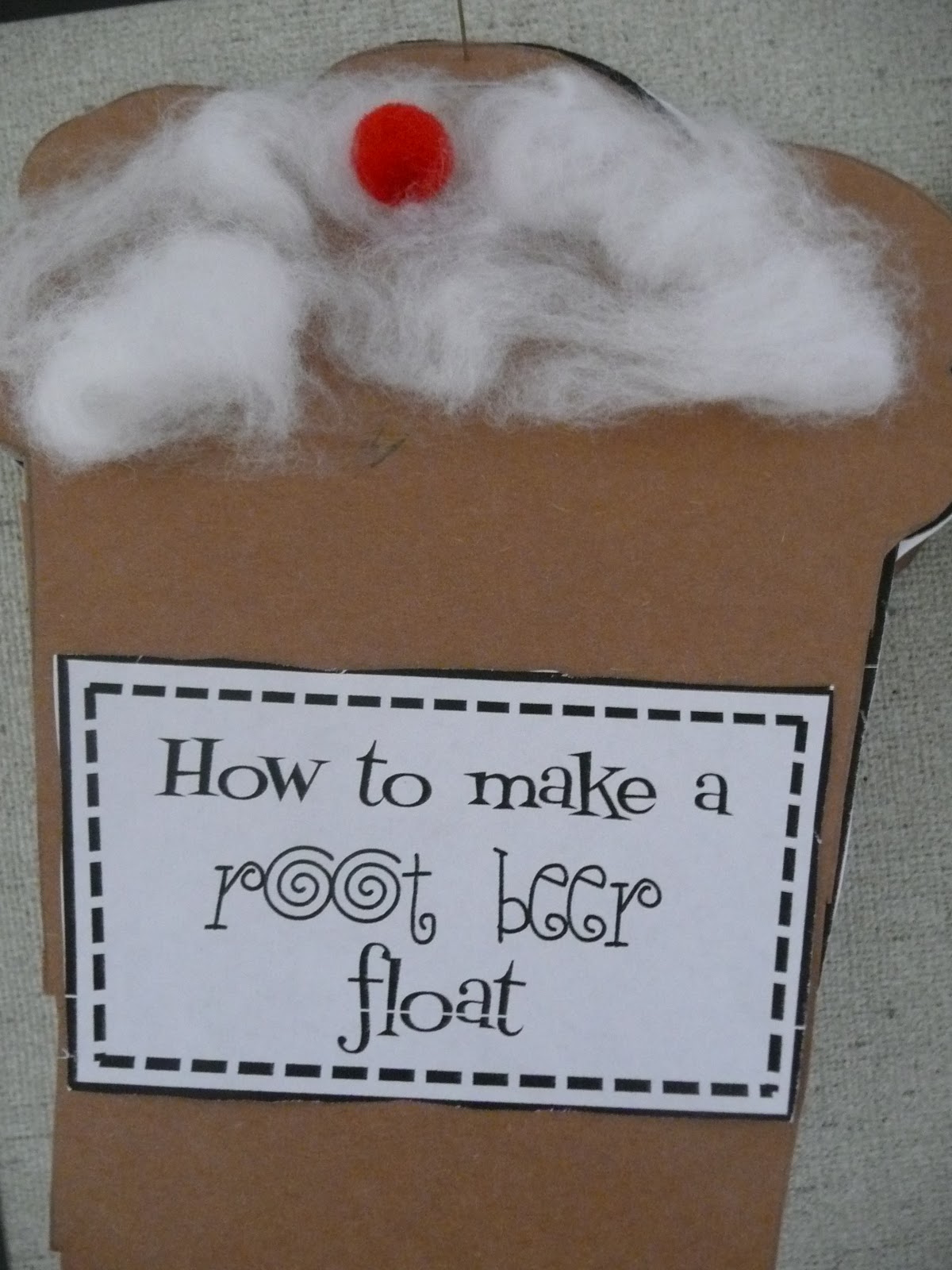
Those delicious root beer floats provided the perfect segway into learning to write to inform.  The students completed a planning sheet, to recognize that when making a float, steps were followed in a certain order.  Using the planning sheet, each student then wrote a book that explains, step by step how to make a root beer float.  


The assignment provides the opportunity for me to assess each students' skills in spelling.  All of the words that they would need were written on their planning sheets.  If a student didn't know how to spell a word independently, they could have referred to the sheet.  When the student doesn't follow through with that opportunity, it alerts me that I must re-teach that lesson, to ensures that all students know that there are many ways to help themselves to spell words correctly.

Winter is here!

Here's what the well dressed student is wearing this winter season in Mrs. Matheson's class.  Note the covering of every inch of skin eliminating the possibility of frostbite.  The mittens are not just stylish, they are also much thicker than the inexpensive knit gloves that become soaked when snow is played with.  Boots are a must as are the snow pants.  This lovely model is ready for a romp or slide in the snow.  Especially key is the hat that covers the ears, not just a hood.  When the wind blows, she will be toasty warm!  Glad to see the zipper done up right to the neck to ensure no nasty colds will take her away from the times she loves best, learning new things in Mrs. Matheson's class!

Thursday, 17 November 2011

A whole lotta shaking' going on....

We took this day to do a whole lotta learnin' as well.  I used a wonderful resource made up a teacher named Cara Carroll, who has a blog called "First Grade Parade."  She had so many wonderful ideas on how to celebrate the 50th day of school that I knew that the students would both love and benefit from.  We spent the morning really looking at the number 50, recognizing that it is an even number and that there many ways to get to 50, such as counting by 2s, 5s and 10s.  We also compared life in the 50s to life in 2011, recognizing that we might like music, but we don't use LPs today!
The students really enjoyed the chance to dress up, but they know that students in the 1950's would have considered these clothes as just their regular everyday wear.

The students now know what a jukebox, saddle shoes, and dungarees are, as well as knowing that when you learned to read in the 1950's, you might be reading books where Dick and Jane or Tom and Betty were the main characters.

In the afternoon, we all went into our Daily Physical Activity room and took a bunch of fun pictures, both in front of the Jukebox and in our own pink cadillac!

We learned how to do the stroll, the twist, and the jive.

Look at all that 'shakin' going on!

Like the students in the 1950's after dancing so much, these students were a tiny bit thirsty, so what better way to end the day, but with a root beer float!  Our day had come to an end, but I have so many activities that we didn't get to, that I think 50th Day of School, Part Two will be taking place on Monday!  (We just won't be dressing the part!)  Thanks to Mrs. Kaban for providing the music and to our two mom helpers who took pictures and made floats!