Love You

Wednesday, 7 December 2011

Christmas

I feel like this is a "get to know" me confession.  I am a saver.  I can be quite organized, so I can find things easily.  In my "Christmas - Jesus" file that I was looking through today, I tripped over this card that I have kept for a very LONG time.  I grew up in a small community and the priests and nuns came to the school on Wednesday afternoons to teach Catechism (the Orthodox kids didn't have to go!!)
The note is dated Dec. 20, 1968 and says:
Dear Sherry,
Both this year and last year you asked me if I had a list of the prayers you may say to make a crib for Jesus before Christmas.  I found one and I'm sending it to you.  It doesn't have to be followed exactly for all the prayers and acts of kindness you do for Jesus show Him your heart is open to receive Him at Christmas.  Remember the prayer "Come, Lord Jesus, come."  May you have a very Merry Christmas and a Happy New Year. 
Love, 
Sister Veronica

A CRIB FOR JESUS
Bed stead - 4 Stations of the Cross
Spring - Abstain from candy
Mattress - 10 Rosaries
2 Linen sheets - 200 Holy phrases
Blanket - 5 Acts of Contrition
Blue Comforter - 4 Acts of Kindness
White spread - 20 Our Fathers
Pillow slip - 5 Acts of Faith
Gift for Mary - 9 Masses

May your family share the love and joy of knowing Christ has come to fulfill the promise of Our Father.

Tuesday, 6 December 2011

Moongame

Although it may appear at times, that the activities that the students are engaged in are purely 'fun', there is always a basis for that activity in the Alberta Curriculum of Studies.  Today's activity demonstrates an opportunity for the students to "identify how pictures, illustrations and special fonts relate to and enhance print and other media texts". The students read a story by the author/illustrator Frank Asch.  In the story the bear learns how to play hide and seek with a bird.  At night he decides to play hide and seek with the moon. 

We are aware that it is important that the students understand the criteria by which an assignment is being assessed.  In today's case, exemplars were shared to visually demonstrate the difference in the creation of an excellent, proficient and a basic sample of work.  By having those exemplars available, the students can recognize how their own efforts will measure up to what is being expected of them.  When you see assessments attached to assignments, know that the students are given those before the assignment begins, again so that they recognize what criteria is to be used in the assessment process.

Can you find the moon?

Where is the moon hiding in this picture?

Bet you can't find the moon here either!

Tuesday, 29 November 2011

Place Value

The purpose of this blog has always been to allow parents into the world of their children as students, learning new concepts, practising, making mistakes and then finally, after much hard work, being successful.  Sometimes it takes a great long time to understand the value of new ideas.
The best way to learn is to be able to hinge our thoughts and ideas onto a real life experience.  In teacher talk, that is called scaffolding.  The students in Grade two are just beginning to work specifically on the concept of place value for numbers.  I decided that a real life application would be to count groups of objects that are really large.  We read a story about the Masloppy Family who took inventory of various collections of items in their home.  We have been taking inventory of items in our class.  On the first day, pairs of students counted bins of books.  As I watched and listened I finally heard a child count by 2's and not singly.  It was then that I called a math congress.  Basically that is an opportunity for all students to share their ideas in a safe way within the class, knowing that their ideas are valued and helpful to others.
Once we discussed why counting by 2's worked better than counting by 1's (the smart child told us it was much faster!), I encouraged the students to choose other groups to count by.  The group today that was counting keys, decided to count by 2's until 100, then they went onto create another group of 100 and so on.  Here they are using pen and paper to record their ideas.  That's the other thing that is different than when you (parents) went to school.  The teacher doesn't immediately tell you the best way to do something.  The students discover through some trial and error and then through sharing during the math congress, what ways work best for them, or which may be more efficient.


These girls decided originally to count the centicubes by 5's but when they saw how many groups they were getting, they changed their strategy and moved 2 groups of 5 together so they would have groups of 10.  They were making decisions based on their needs in the situations...that's becoming real problem solvers!
It was also interesting to hear  one girl share that when she was making groups of 5, she looked for groups of 2 and groups of 3 to put together (rather than counting individually up to 5).  She is demonstrating her understanding of composing (putting together) numbers!

Finally, another girl shared that she and her partner chose different groups to count by depending on how many items were in the container they were going to count.  If the amount seemed small, they counted by 2's, but if the amount was larger, they grouped by 5's and when they thought the amount would be very  large, they then used groups of 10's.  Math is about making sense of the world around you.  Listen to how your child is thinking BEFORE telling them how you would solve the problem!

Sunday, 27 November 2011

Attributes

What are attributes?  Why are they important?  What subject would we use them in?

Attributes are the characteristics of something that we are discussing.  They are important because they show the similarities and the differences between a number of objects.  For that reason we use them in all subject areas.  Currently and concretely, the students are looking at how to sort objects by attributes in mathematics.  How are the keys the same?  Sort them into two or more groups and ask your partner to name the attributes that you were using to create the groups.  For example, you can sort buttons by the number of holes they have or sort keys by the shape of the tops.

What attributes did the girls use to sort these flowers?

How to Blow a Bubble

The fun of the Fiftieth Day of School just keeps hanging on!  Writing non-fiction is very different than writing fiction and having some experiences to 'hinge' our understanding onto makes the actual exercise much easier.  Bubblegum was a relatively new chewing delight in the 1950's and being able to blow a bubble with gum is a sign that you are really growing up!

What are the items that are needed if you want to blow a bubble? What are the steps to creating a bubble?  Could you write these down in full sentences in order and have a reader follow them?


When the students write their sentences, they have had the opportunity to try, to talk and share with others, have created a plan and have reminded to use the mechanics of writing appropriately.  For all of that, you will notice that some still do not start sentences with an uppercase letter, end with punctuation or spell the words (or copy them) correctly.  That makes the difference when assessment is being done.

Whisper Phones

A HUGE "thank you" to the Parent Council at Jean Vanier Catholic School for supporting our request for ten 'whisper phones' for our classroom.  These simple devices allow the students to read to themselves, hearing their own voices among the multitudes of noises created in a hectic classroom.  Being able to hear yourself read can be very important to a student who is still not ready for 'silent reading'.  Knowing what the sentence sounded like allows for better comprehension.  The students love these so much!

Tuesday, 22 November 2011

The Fabulous Fifties continue.....

Last Thursday just wasn't long enough to complete all the ideas that I had found in a wonderful pack from Cara Carroll, a blogger at First Grade Parade. It's wonderful to have a fun day full of activities that the students will remember, but every activity also has a connection to our curriculum objectives.

Here the students had an opportunity to compare their life to the life of others in the 1950's.  They practiced writing a comparative sentence with the joining word but.

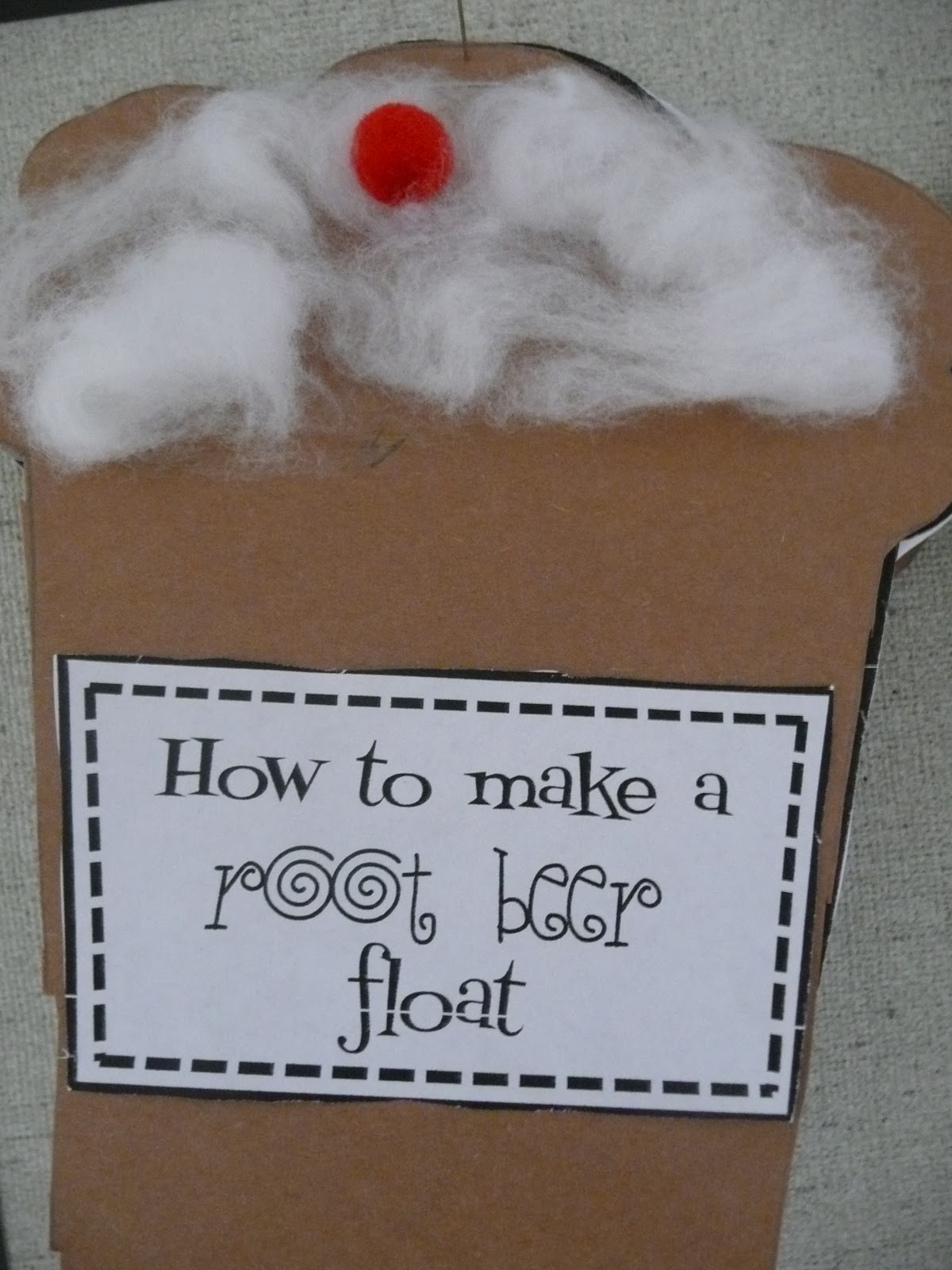
Those delicious root beer floats provided the perfect segway into learning to write to inform.  The students completed a planning sheet, to recognize that when making a float, steps were followed in a certain order.  Using the planning sheet, each student then wrote a book that explains, step by step how to make a root beer float.  


The assignment provides the opportunity for me to assess each students' skills in spelling.  All of the words that they would need were written on their planning sheets.  If a student didn't know how to spell a word independently, they could have referred to the sheet.  When the student doesn't follow through with that opportunity, it alerts me that I must re-teach that lesson, to ensures that all students know that there are many ways to help themselves to spell words correctly.